
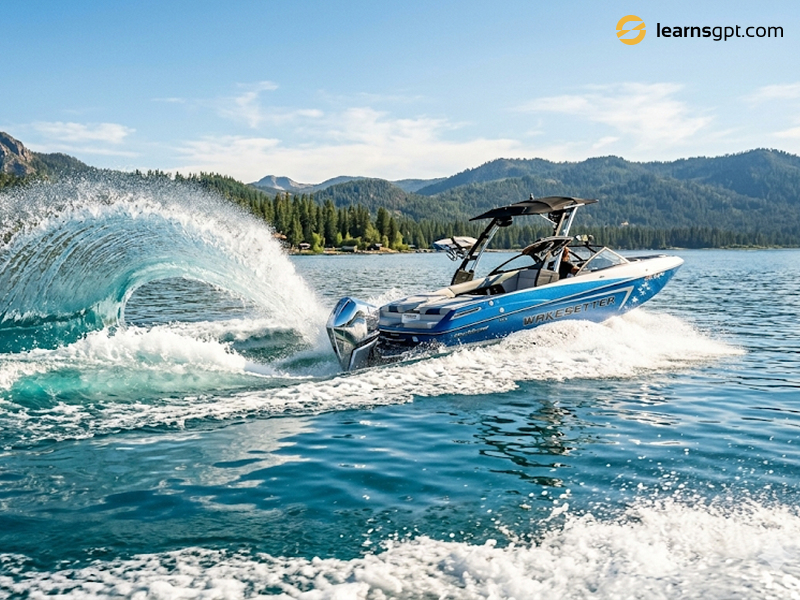
If you have ever watched someone wakeboard or wakesurf behind a modern towboat without holding a rope, you have probably asked yourself: how is a ski boat designed for making waves that are so massive and endless?
Unlike traditional speedboats or fishing boats, which are engineered to cut through the water smoothly with minimal resistance, a wake boat is built to do the exact opposite. It is engineered to displace as much water as possible. By pushing water out of the way, the boat creates a controlled, surfable wave.
In this comprehensive marine engineering guide, we will dive into the physics of water displacement and reveal the five key features that explain how is a ski boat designed for making waves.
The Physics of Water Displacement
Before exploring the mechanical parts, we must understand the basic physics. When a boat moves, it pushes water down and out of the way to make room for its hull. As the boat moves forward, that displaced water rushes back in to fill the empty space, crashing together behind the boat to form a wake (wave).
If you want a bigger wave, you have to push the boat deeper into the water. This requires heavy engineering. To learn more about general boating safety and engineering standards, you can check out the official resources at Discover Boating.
5 Features: How is a Ski Boat Designed for Making Waves?
So, mechanically speaking, how is a ski boat designed for making waves? Here are the five core engineering secrets used by top manufacturers like Malibu, MasterCraft, and Nautique.
The V-Drive Engine Placement
Traditional ski boats (for slalom skiing) have the engine in the middle of the boat to keep the boat flat and the wake incredibly small. Wake boats, however, use a “V-Drive” system. The heavy engine is placed at the very back (stern) of the boat. This naturally sinks the back of the boat deeper into the water, plowing up a larger wave.
Internal Ballast Systems
This is the most crucial element when asking how is a ski boat designed for making waves. These boats have massive hard tanks and soft bags hidden under the floorboards and seats. With the push of a button, pumps fill these tanks with thousands of pounds of lake water. This extreme added weight sinks the hull deep into the water, creating a massive displacement wave. When you are done surfing, the pumps empty the water back into the lake.
Specialized Hull Design
A normal boat has a hull designed to glide over the water (planing). A wake boat has a specialized, deeper “V” shaped hull that is designed to slice through the water while simultaneously dragging the rear end down.
Wake Shaping Plates and Tabs
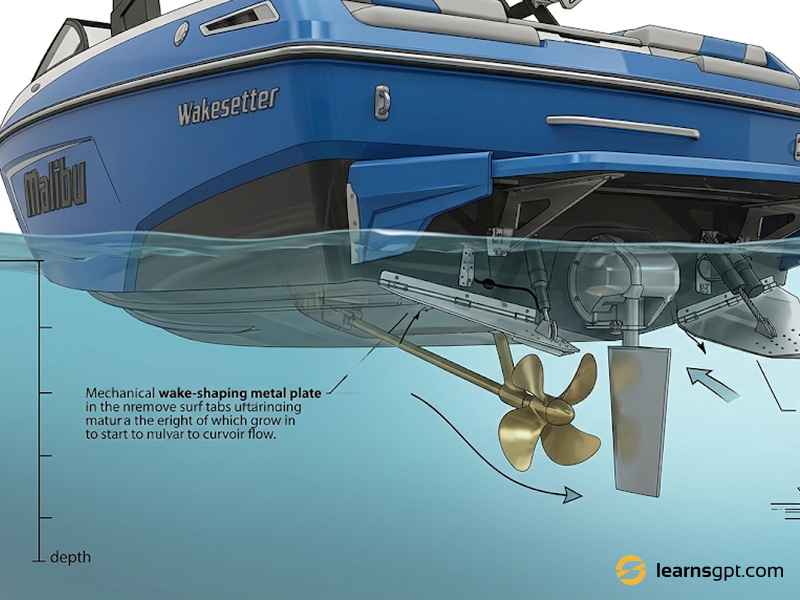
In the past, surfers had to move heavy lead weights and passengers around the boat to lean it to one side. Today, boats feature hydraulic metal plates (often called Surf Gates or Gen 2 Surf Systems) on the back corners. These plates deploy into the water to delay the flow of water on one side. This sculpts the chaotic wake into a smooth, clean, perfectly curled surfing wave on either the left or right side of the boat.
Inboard Propellers for Safety
You cannot safely wakesurf closely behind a boat that has an exposed outboard motor. Wake boats use an “inboard” design. The propeller is located entirely underneath the boat, far away from the surfer. This keeps the surfer completely safe if they fall forward into the wave.
Water Skiing vs. Snow Skiing: Prepare Your Calves
Now that you know how is a ski boat designed for making waves, you need to make sure your body is ready to ride them!
Water skiing and wakeboarding demand incredible lower-body strength. The biomechanics of standing on a board while a boat pulls you through choppy water puts massive tension on your lower legs. If you have ever hit the winter slopes and wondered why do my calves hurt after skiing, you will experience that exact same muscle fatigue on the lake!
Whether on snow or water, your calf muscles (the gastrocnemius and soleus) act as your primary shock absorbers. If you do not stretch before jumping behind the boat, that tension will transfer to your shin bones. In fact, many water sports athletes experience severe pain simply because tight calves cause shin splints. Always stretch and hydrate before surfing!
Frequently Asked Questions (FAQs)
Can a regular speed boat make a surfing wave?
No, a regular speed boat is generally too light and its hull is designed to ride on top of the water. Furthermore, most speed boats have exposed outdrive propellers (I/O motors), making it incredibly dangerous and even illegal to wakesurf behind them.
Exactly how is a ski boat designed for making waves on only one side?
Modern wake boats use hydraulic metal tabs or plates (like a Surf Gate) attached to the rear transom. By deploying a plate on the right side of the boat, it disrupts the water flow and creates a perfectly shaped, clean surfing wave on the left side of the boat.
How much weight is needed to make a good wake?
Most modern wake boats use between 2,000 and 5,000 pounds of water ballast to sink the boat deep enough to create a professional-sized surfing wave.
Does making massive waves use more gas?
Yes, significantly more. Because the boat is heavily weighted down with water ballast and is constantly pushing a massive wall of water, the engine has to work much harder. Wake surfing consumes fuel much faster than normal cruising.
What is the difference between a wakeboard boat and a slalom ski boat?
A slalom ski boat has a flat hull, a direct-drive engine in the middle, and is designed to create the smallest, flattest wake possible so the skier can cross it smoothly. A wakeboard boat has a V-drive engine in the back and is designed to create massive, ramp-like waves for jumping and surfing.