

Learning how to get massive calves is often considered the holy grail of bodybuilding. While some people are naturally blessed with thick lower legs, the rest of us have to fight for every single inch of muscle growth.
Having “big” calves is one thing, but building truly massive, vascular, and diamond-shaped calves requires a completely different level of dedication. If you have been doing a few half-hearted calf raises at the end of your leg day and wondering why they aren’t growing, it is time for a reality check.
In this advanced guide, we will break down the absolute best strategies on how to get massive calves, the hardcore rules you need to follow, and the mistakes keeping your legs small.
Bigger vs. Massive: What is the Difference?
Before we dive in, let’s establish a baseline. If you are a complete beginner just looking for basic muscle tone and slight growth, you should start with our foundational guide on how to make your calves bigger.
However, if your goal is extreme hypertrophy—meaning you want your lower legs to look like bowling balls—you need to shock the muscles. The calf complex (the gastrocnemius and soleus) is used to carrying your body weight all day. To force them to mutate and grow massive, you must subject them to extreme loads and brutal intensity.
For a deep dive into the science of extreme muscle hypertrophy, check out this comprehensive study on muscle growth mechanisms by PubMed.
5 Hardcore Rules: How to Get Massive Calves
If you are serious about transforming your physique, here is exactly how to get massive calves using proven bodybuilding principles.
Overload with Ridiculous Weight
Your calves support you when you walk, run, and jump. They are already used to high volume. To shock them, you must lift heavy. Load the standing calf raise machine with weights that genuinely scare you. Aim for sets of 6 to 8 reps where the last rep requires absolute maximum effort.

Master the Three-Second Pause
If you bounce the weight, you are using your Achilles tendon, not your muscle. The true secret of how to get massive calves lies in the stretch. Drop your heels as low as possible and hold that painful stretch for a full three seconds before exploding upward. This eliminates momentum and forces the muscle fibers to do 100% of the work.
High Frequency is Mandatory
You cannot train calves once a week and expect them to become huge. These muscles recover exceptionally fast. You need to train them at least 3 to 4 times a week. Alternate between heavy, low-rep days (for the fast-twitch fibers) and lighter, high-rep days (for the slow-twitch fibers).
Barefoot Training
Many golden-era bodybuilders swore by barefoot calf training. Without the thick rubber sole of a running shoe absorbing the impact and altering the angle, your calf muscles and foot stabilizers are forced to contract much harder. Try doing your seated calf raises in just your socks.
Prioritize the Soleus for Width
The gastrocnemius gives your calf that “diamond” look from the back, but the soleus (the muscle underneath) gives your lower leg its overall thickness and width. The only way to target the soleus is by doing seated calf raises with your knees bent.
The Importance of Tracking Your Size
When you are figuring out how to get massive calves, the mirror can be deceiving. Muscle dysmorphia is real, and you might think you aren’t growing even when you are.
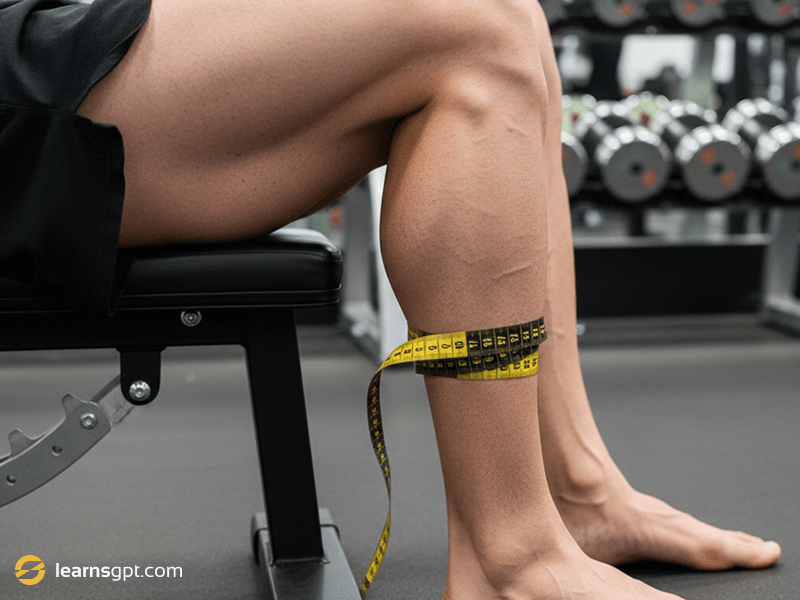
You must measure your legs accurately every month to ensure your hardcore training program is working. Grab a soft tape measure and follow our exact step-by-step guide on how to measure calves to track your actual hypertrophy progress.
Preventing Lower Leg Injuries
When you apply extreme weight and volume to your lower legs, they will become incredibly tight. If you neglect stretching and deep tissue massage, this tightness will pull on your tibia bone.
Many bodybuilders develop severe pain because tight calves cause shin splints. Always dedicate at least 10 minutes to foam rolling your lower legs after a brutal calf workout to maintain flexibility and prevent injuries.
Frequently Asked Questions (FAQs)
Is it actually possible to get massive calves with bad genetics?
Yes. While genetics determine where your calf muscle inserts (high or low on the leg), extreme hard work, heavy progressive overload, and high-frequency training can add massive size to any calf, regardless of genetics.
How long does it take to get massive calves?
Building extreme muscle mass takes time. With a dedicated, heavy training routine 3-4 times a week, you can expect to see significant changes in 3 to 6 months. For “massive” bodybuilding-level size, it takes years of consistency.
Should I do calf raises fast or slow?
Always perform calf raises slowly and with control. Explode up to the top, squeeze for one second, lower the weight slowly over three seconds, and pause at the bottom stretch for two to three seconds.
Why are my calves not growing even though I train them?
The most common reasons are: you are not lifting heavy enough, you are bouncing the weight and using your Achilles tendon, or you are leaving calf training to the very end of your workout when you have no energy left.
Do I need to take supplements to get massive calves?
While you don’t “need” supplements, consuming adequate protein is non-negotiable for muscle growth. Creatine monohydrate is also highly recommended, as it increases your strength output and pulls water into the muscle cells, making your calves look fuller and more massive.